Yamaguchi Prefecture
Western Honshu prefecture with samurai history and industrial growth.

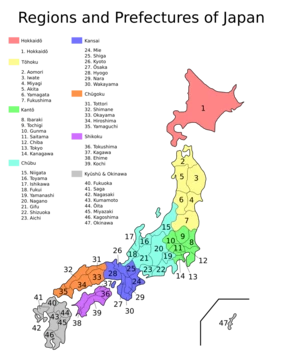
Yamaguchi Prefecture (山口県, Yamaguchi-ken) is a prefecture of Japan located in the Chūgoku region of Honshu. It has a population of 1,377,631 (1 February 2018) and a geographic area of 6,112 km² (2,359 sq mi). Yamaguchi is the capital and Shimonoseki is the largest city. The prefecture borders Shimane Prefecture to the north and Hiroshima Prefecture to the northeast, and is located at the western tip of Honshu with coastlines on the Sea of Japan and Seto Inland Sea, separated from Kyushu by the Kanmon Straits. Yamaguchi Prefecture was created by the merger of the provinces of Suō and Nagato.
- Capital
- Yamaguchi
- Largest City
- Shimonoseki
- Population
- 1,377,631 (as of 1 February 2018)
- Area
- 6,112 km² (2,359 sq mi)
- Region
- Chūgoku, Honshu, Japan
Verified Timeline
Lore & Background
Yamaguchi Prefecture was created by the merger of the provinces of Suō and Nagato. During the Heian and Kamakura periods (794–1333), the Ouchi family of Suō Province and the Koto family of Nagato Province gained influence as powerful warrior clans. In the Muromachi period (1336–1573), Ouchi Hiroyo, the 24th ruler of the Ouchi family, conquered both areas. The Ouchi clan imitated the city planning of Kyoto, gaining wealth through cultural imports and trade with Korea and Ming Dynasty China, earning Yamaguchi the nickname 'Kyoto of the West.' Sue Harutaka defeated the 31st ruler of the Ouchi clan, but the Sue clan was then defeated by Mōri Motonari, giving the Mōri family control of the Chūgoku region. Mōri Terumoto was defeated by Tokugawa Ieyasu at the Battle of Sekigahara in 1600 and was forced to give up all land except Suō and Nagato (current-day Yamaguchi Prefecture), where he built his castle in Hagi and launched the Three Whites campaign (salt, rice, paper). After Commodore Matthew Perry's opening of Japan, clans from Nagato (also called Chōshū) played a key role in the fall of the Tokugawa shogunate and the establishment of the new imperial government.
Reader's Guide
Yamaguchi Prefecture's significance lies in its role in the Meiji Restoration, with clans from Nagato (Chōshū) key in overthrowing the Tokugawa shogunate. Four years after the Edo Shogunate was overthrown and the Meiji government formed in 1868, the present Yamaguchi Prefecture was established. The Meiji government promoted modern industry, though the prefecture was still centered on agriculture during this period. In the Taishō period (1912–1926), shipbuilding, chemical, machinery, and metalworking plants were built in Yamaguchi's harbors in the Seto Inland Sea area. During the post-World War II Shōwa period, Yamaguchi developed into one of the most industrialized prefectures due to petrochemical complexes. For development analysis, Yamaguchi is construed to be part of Northern Kyushu, functioning as a satellite of the Kanmon Straits metropolitan area. Tourism highlights include Shimonoseki's Karato Fish Market and large fireworks festival in summer, Iwakuni's five-arched Kintai Bridge (a symbol of Western Honshū), Hagi's traditional city with green or brown post boxes and a World Heritage Site reverberatory furnace, and Akiyoshidai Quasi-National Park featuring Japan's longest cave, Akiyoshido. The prefecture has ferry connections to Busan (South Korea), Qingdao and Shanghai (China), and is home to universities including Yamaguchi University and National Fisheries University.
Did You Know?
- Yamaguchi Prefecture was created by the merger of the provinces of Suō and Nagato.
- During the Muromachi period, Yamaguchi came to be known as the 'Kyoto of the West' due to the Ouchi clan's cultural imports and trade with Korea and Ming Dynasty China.
- Mōri Terumoto, after his defeat at the Battle of Sekigahara in 1600, was forced to give up all land except Suō and Nagato, where he built his castle in Hagi.
- In Hagi City, post boxes are painted green or brown instead of the usual red found elsewhere in Japan.
- The prefecture has regular ferry services from Shimonoseki Port International Terminal to Busan (South Korea), Qingdao (China), and Shanghai (China).
Frequently Asked Questions
Who is Yamaguchi Prefecture?
Yamaguchi Prefecture is a western Honshu prefecture in Japan's Chūgoku region, formed from the old provinces of Suō and Nagato. Its capital is Yamaguchi city, while its largest urban center is Shimonoseki.
What are Yamaguchi Prefecture's powers/role?
It is most celebrated for its central role in the Meiji Restoration, where anti-shogunate forces based in the region helped dismantle the Tokugawa government. Beyond that legacy, the prefecture is recognized for its industrial base and scenic attractions such as Kintai Bridge and Akiyoshido Cave.
How does Yamaguchi Prefecture's story end?
Its historical arc reaches its climax in the early 1860s, when local domains rallied behind the imperial cause and helped end more than two centuries of Tokugawa rule. The prefecture now continues as a modern administrative region home to roughly 1.38 million residents spread over about 6,112 square kilometers.
Why is Yamaguchi Prefecture important?
It served as a crucial staging ground for the forces that overthrew the shogunate, a role that sharpened after Commodore Perry's arrival exposed Japan's military weakness. Its position at the far western tip of Honshu also made it a natural hub for maritime trade and later industrial growth.
What 'clan' or background does Yamaguchi Prefecture come from?
The region was historically ruled by the Ouchi, Sue, and Mōri samurai clans before the modern prefecture was established. That layered samurai heritage remains a core part of local identity and is frequently cited by fans as the prefecture's defining backstory.
More in Japanese Prefectures 1-24
Elsewhere in the Japanese Prefectures universe
Spotted an error? Know more?
This is a living reference — every entry is fact-audited, and reader corrections feed straight into our audit queue. Suggest an edit · See this site's audit record