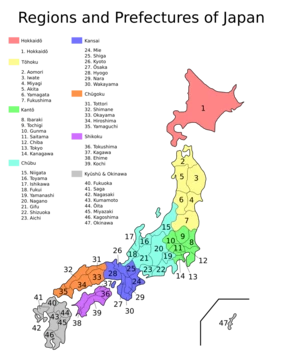
Niigata Prefecture
Fifth-largest prefecture by area, leading rice producer.

Niigata Prefecture is a prefecture in the Chūbu region of Honshu, Japan, with a population of 2,071,066 as of 1 October 2025. It is the fifth-largest prefecture by geographic area at 12,584.18 km² and contains the Niigata Major Metropolitan Area, the largest metropolitan area on the Sea of Japan coast. Historically part of Echigo Province and Sado Province, Niigata Prefecture is known for its agricultural output, particularly rice, and for being the first Japanese port on the Sea of Japan opened to foreign trade after Matthew Perry.
- Capital
- Niigata
- Population
- 2,071,066 (as of 1 October 2025)
- Area
- 12,584.18 km²
- Region
- Chūbu region, Honshu
- Major Metropolitan Area Population
- 1,395,612
- Largest City
- Niigata
Verified Timeline
Lore & Background
Until after the Meiji Restoration, the area now Niigata Prefecture was divided into Echigo Province and Sado Province. During the Sengoku period, the Nagao clan ruled a fief in the western part from Kasugayama Castle; the most notable member was Nagao Kagetora, later known as Uesugi Kenshin, who unified Echigo Province. The city of Niigata was the first Japanese port on the Sea of Japan opened to foreign trade following the opening of Japan by Matthew Perry, and it has since played an important role in trade with Russia and Korea, with a freighter from North Korea visiting once a month.
Reader's Guide
Niigata Prefecture holds significance as Japan's leading rice producer, particularly the Koshihikari variety from the Uonuma area, and ranks third in sake production. Its economy also includes crude oil production, gold mining on Sado Island until 1989, and manufacturing of 90 percent of Japan's silverware in Sanjō and Tsubame. The prefecture experienced major earthquakes in 2004, 2006, and 2007, and a heavy winter storm in 2006 that killed at least 71 people. Culturally, Niigata hosts the Fuji Rock Festival at the Naeba ski resort, one of Japan's largest outdoor music events, and is the setting for Yasunari Kawabata's novel 'Snow Country'. Its population declined by 103,000 between 2015 and 2020, the second largest decline among prefectures after Hokkaido.
Did You Know?
- Niigata Prefecture is the fifth-largest prefecture of Japan by geographic area at 12,584.18 km².
- The Niigata Major Metropolitan Area, with a population of 1,395,612, is the largest metropolitan area on the Sea of Japan coast.
- Niigata Prefecture ranks first in Japan in rice output, followed by Hokkaido and Akita.
- A freighter from North Korea visits Niigata once a month, in one of the few forms of direct contact between Japan and that country.
- The prefecture's population decreased by 103,000 between 2015 and 2020, the second largest decline after Hokkaido.
The Uesugi Legacy and the Opening of a Port
During the Sengoku period, the Nagao clan governed a fief in western Echigo from Kasugayama Castle, serving at times as vassals to the Uesugi. The clan's most celebrated figure, Nagao Kagetora, later known as Uesugi Kenshin, unified the scattered leaders of Echigo Province and assumed the Uesugi name, effectively consolidating their entire realm under his command. Centuries later, the city of Niigata became the first port on the Sea of Japan coast to open to foreign trade following Matthew Perry's arrival, cementing its role in international commerce. That maritime connection endures to this day: a North Korean freighter still calls at Niigata monthly, maintaining one of the few direct channels of contact between Japan and that isolated nation. Today, Niigata stands as the third-largest Japanese city facing the Sea of Japan, behind only Fukuoka and Kitakyushu, and anchors the largest metropolitan area on that coast with a population of 1,395,612.
A Prefecture Built on Rice and Craft
Niigata's economic identity is inseparable from the paddy field. The prefecture ranks first among all Japanese prefectures in rice output, edging out Hokkaido and Akita, and the Uonuma area is celebrated for producing Koshihikari, a variety widely regarded as the highest-quality rice produced in Japan. That grain feeds an entire ecosystem of food culture: Niigata is nationally renowned for its sake, placing third behind Gunma and Kyoto, as well as for senbei, mochi, and arare. Beyond the kitchen, the prefecture's craft traditions are equally remarkable. Sanjō and Tsubame together produce ninety percent of Japan's silverware and rank second only to Osaka in scissors, kitchen knives, nail clippers, and wrenches. The ornamental koi carp also traces its origin to this region. In horticulture, Niigata leads the nation in azaleas and cut lilies, and alongside Toyama produces the highest volume of tulips.
A Coastline Shaped by Storms and Quakes
Niigata stretches roughly 240 kilometers along the Sea of Japan, a long coastal plain wedged between mountain ranges and the open water. That geography brings both beauty and peril. On October 23, 2004, the Chūetsu earthquake struck, registering Shindo 6+ at Ojiya. Just over a year later, a brutal winter storm in January 2006 killed at least 71 people and injured more than a thousand across the prefecture and its neighbors. That same year, a massive tsunami and earthquake battered the maritime areas, particularly near Sado Island, destroying homes and causing casualties. Another earthquake followed on July 16, 2007. Yet the landscape also holds extraordinary natural wealth: a quarter of the prefecture's total land area is designated as Natural Parks, encompassing Bandai-Asahi, Chūbu-Sangaku, Nikkō, and Oze National Parks, along with Echigo Sanzan-Tadami and Sado-Yahiko-Yoneyama Quasi-National Parks and thirteen Prefectural Natural Parks. The mouth of the Shinano River, Japan's longest, is located in Niigata Prefecture.
Political Clout and the Modern Stage
In the 1960s and 1970s, the Etsuzankai political organization, led by the powerful figure Kakuei Tanaka, wielded considerable influence in securing major infrastructure for the prefecture. Among its achievements were the Jōetsu Shinkansen high-speed rail line and the Kanetsu Expressway connecting Niigata to Tokyo, projects that reshaped the region's connectivity. The prefecture also hosted a nuclear power plant in the tiny village of Kariwa, which at one point held the distinction of the world's highest energy output, though it was shut down following the Fukushima Daiichi disaster. Crude oil is produced locally, and kerosene heaters are manufactured for the region's cold winters. On the cultural front, Niigata is home to the Fuji Rock Festival, a three-day outdoor music event held at the Naeba ski resort and organized by Smash Japan. Featuring over 200 Japanese and international acts, it draws more than 100,000 attendees and stands as one of Japan's largest outdoor music gatherings. Sado Island, the sixth-largest island of Japan in area following the four main islands and Okinawa Island, adds yet another dimension to this diverse prefecture.
Frequently Asked Questions
Who is Niigata Prefecture?
Niigata Prefecture is a Chūbu-region prefecture on Honshu's Sea of Japan coast, ranking fifth in Japan by geographic area at roughly 12,584 square kilometers. Its capital and largest city, also named Niigata, anchors the biggest metropolitan area along the Sea of Japan side of the country.
What are Niigata Prefecture's powers and role?
Niigata holds the top spot as Japan's leading rice producer, making it a cornerstone of the nation's agricultural output. It also carries the historical badge of being the first Sea of Japan port opened to foreign trade after Matthew Perry's arrival, giving it a distinctive place in Japan's modernization narrative.
Where is Niigata Prefecture based?
Niigata stretches along the Sea of Japan coast in the Chūbu region of Honshu, absorbing the old Echigo and Sado provinces. Its Niigata Major Metropolitan Area shelters about 1.4 million residents, the largest urban cluster on that entire coastline.
Why is Niigata Prefecture important?
Beyond its #1 rice-production title, Niigata is the fifth-largest prefecture by area and the economic heart of the Sea of Japan coast. Its early role as a foreign-trade gateway and its continued agricultural dominance keep it central to both Japan's history and its food supply.
How does Niigata Prefecture's story end?
As of October 2025, Niigata Prefecture counts roughly 2.07 million residents and remains an active, ongoing presence rather than a concluded arc. Its rice fields, coastal city, and metropolitan area continue to define the Chūbu region's Sea of Japan identity.
More in Japanese Prefectures 1-24
Elsewhere in the Japanese Prefectures universe
Spotted an error? Know more?
This is a living reference — every entry is fact-audited, and reader corrections feed straight into our audit queue. Suggest an edit · See this site's audit record