Aichi Prefecture
Aichi Prefecture is Japan's industrial heartland and home to Toyota.

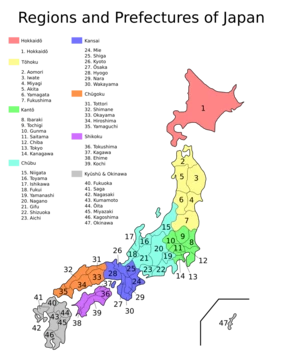
Aichi Prefecture (愛知県, Aichi-ken) is a prefecture of Japan located in the Chūbu region of Honshū. It has a population of 7,461,111 as of 1 January 2025 and a geographic area of 5,172.92 square kilometres (1,997.28 sq mi), with a population density of 1,442 inhabitants per square kilometre (3,730/sq mi). Nagoya is the capital and largest city of the prefecture. Aichi Prefecture borders Mie Prefecture to the west, Gifu Prefecture and Nagano Prefecture to the north, and Shizuoka Prefecture to the east. It forms the core of the Chūkyō metropolitan area, the third-largest metropolitan area in Japan, and is home to the Toyota Motor Corporation.
- population
- 7,461,111 (as of 1 January 2025)
- area
- 5,172.92 square kilometres (1,997.28 sq mi)
- population_density
- 1,442 inhabitants per square kilometre (3,730/sq mi)
- capital
- Nagoya
- region
- Chūbu region, Honshū
Verified Timeline
Lore & Background
Originally divided into the provinces of Owari and Mikawa, the area was unified after the Meiji Restoration. In 1871, Owari, with the exception of the Chita Peninsula, was established as Nagoya Prefecture, while Mikawa combined with the Chita Peninsula and formed Nukata Prefecture. Nagoya Prefecture was renamed to Aichi Prefecture in April 1872 and was united with Nukata Prefecture on 27 November of the same year. The prefecture's name derives from the ancient Ayuchi tidal flats, referenced in a poem from the third volume of the Man'yōshū by Takechi Kurohito: 'The cry of the crane, calling to Sakurada; it sounds like the tide, draining from Ayuchi flats, hearing the crane cry.' The Fujimae tidal flat is all that remains of the earlier Ayuchi-gata and is now a protected area. The Expo 2005 World Exposition was held in Seto and Nagakute.
Reader's Guide
Aichi Prefecture holds significant economic and historical importance in Japan. Its gross domestic product in 2018 was the second largest in Japan, the shipment value of manufactured goods in 2018 was the first in Japan, annual product sales in 2019 was the third largest in Japan, and its agricultural output in 2018 was eighth in Japan. The prefecture is the global headquarters of the Toyota Motor Corporation and hosts major facilities for companies such as Fuji Heavy Industries, Mitsubishi Motors, Pfizer, Sony, Suzuki, Bodycote, and Volkswagen Group. Its industrial structure is well-balanced, with agriculture, industry, and commerce all ranking highly. Culturally, Aichi is home to notable sites including the Meiji Mura open-air architectural museum in Inuyama, which preserves buildings from the Meiji and Taishō periods, including the reconstructed lobby of Frank Lloyd Wright's old Imperial Hotel. The prefecture also features the Higashiyama Zoo and Botanical Gardens, Chubu Centrair International Airport, and Legoland Japan Resort. Aichi's population was the fastest-growing in Japan from October 2005 to October 2006, beating Tokyo at 7.4%.
Did You Know?
- The name Aichi derives from the ancient Ayuchi tidal flats, referenced in a poem from the third volume of the Man'yōshū by Takechi Kurohito.
- Aichi Prefecture was the fastest-growing prefecture in Japan from October 2005 to October 2006, beating Tokyo at 7.4%.
- The highest point in Aichi Prefecture is Chausuyama at 1,415 m (4,642 ft) above sea level.
- As of 1 April 2012, 23% of the prefecture's total land area was designated as Natural Parks.
- The Expo 2005 World Exposition was held in Seto and Nagakute.
Geography & Natural Landscape
Aichi Prefecture sits near the center of Honshu, Japan's main island, stretching roughly 106 kilometers east to west and 94 kilometers south to north. Its southern coastline opens onto the Ise and Mikawa Bays. The terrain encompasses a major portion of the Nōbi Plain, while the highest point, Chausuyama, rises to 1,415 meters above sea level. The western portion is dominated by Nagoya, Japan's fourth-largest city, and its suburbs, whereas the eastern section, though less densely settled, still hosts several significant industrial centers. As of 1 April 2012, 23% of the prefecture's total land area was designated as Natural Parks, namely the Aichi Kōgen, Hida-Kisogawa, Mikawa Wan, and Tenryū-Okumikawa Quasi-National Parks along with seven Prefectural Natural Parks. With a total area of 5,172.48 square kilometres (1,997.11 sq mi), Aichi accounts for approximately 1.36% of Japan's total surface area, bordered by Mie to the west, Gifu and Nagano to the north, and Shizuoka to the east.
Economic Engine & Industrial Identity
Aichi Prefecture stands as one of Japan's most economically vital regions, ranking second in the nation for gross domestic product as of 2018. Its shipment value of manufactured goods claimed the top national position that same year, while annual product sales placed it third and agricultural output eighth. The prefecture's industrial structure is notably well-balanced across multiple sectors, with aerospace, automotive manufacturing, ceramics, and steel and alloy production all playing central roles. Toyota Motor Corporation, headquartered in Aichi, anchors the automotive landscape, and the prefecture also hosts plants or branch offices for major names including Fuji Heavy Industries, Mitsubishi Motors, Pfizer, Sony, Suzuki, Bodycote, and Volkswagen Group. This concentration of manufacturing talent and infrastructure has made Aichi a magnet for population growth; during the period from October 2005 to October 2006, it was the fastest-growing prefecture in Japan by population, beating Tokyo at 7.4%. The Chūkyō metropolitan area, formed by Aichi and Nagoya, ranks as the third-largest in Japan and among the largest in the world.
Historical Formation & the Name Aichi
The territory now known as Aichi Prefecture was originally split between two distinct provinces: Owari and Mikawa. Following the Meiji Restoration and the 1871 abolition of the han system, these provinces were reorganized into separate administrative units. Owari, excluding the Chita Peninsula, became Nagoya Prefecture, while Mikawa combined with the Chita Peninsula to form Nukata Prefecture. In April 1872, Nagoya Prefecture was renamed Aichi, and on 27 November of the same year, it was formally united with Nukata to create the modern prefecture. The name itself carries deep literary roots: in the third volume of the Man'yōshū, the poet Takechi Kurohito composed a verse referencing Ayuchi flats, the original form of the name, describing the sound of a crane's cry echoing like tides draining from the flats. The Fujimae tidal flat, a remnant of the ancient Ayuchi-gata, survives today as a protected area. The prefectural government office remains in Nagoya, the historic capital of Owari, and the Aichi Prefectural Police have maintained law enforcement in the region since 1871.
Transportation Network & Global Connectivity
Aichi Prefecture boasts one of Japan's most layered and interconnected transportation systems. Its rail network spans multiple operators: JR Central runs the Tokaido Shinkansen high-speed line alongside the Tokaido, Chūō Main, Kansai, Taketoyo, and Iida lines. Meitetsu operates an extensive web of routes including the Nagoya, Inuyama, Komaki, Centrair, Tokoname, Seto, Toyokawa, Gamagori, Toyota, Chita, Mikawa, Bisai, Chikko, and Tsushima lines. Kintetsu serves the Nagoya and Aonami corridors, while the Nagoya Municipal Subway provides six urban lines—Higashiyama, Meijo, Tsurumai, Sakura-dori, Meiko, and Kamiiida—several of which interconnect with Meitetsu routes. The Toyohashi Railroad's Aichi Loop Line and the Linimo people-mover add further connectivity. For air travel, Chubu Centrair International Airport and Nagoya Airfield serve the region. Maritime access is provided through Kinuura Port in Handa and Hekinan, Mikawa Port (mainly automobile and car parts export), and Nagoya Port, which functions as an international container hub with ferry routes to Sendai and Tomakomai in Hokkaido.
Frequently Asked Questions
Who is Aichi Prefecture?
Aichi is a Chūbu-region prefecture on Honshū whose seat sits in Nagoya. It is the third most populous prefecture in Japan, packing over 7.4 million residents into roughly 5,173 square kilometres.
What are Aichi Prefecture's powers/role?
It functions as Japan's manufacturing and automotive engine, housing the Toyota Motor Corporation headquarters. The prefecture also anchors the Chūkyō metropolitan area, the nation's third-largest urban cluster.
How does Aichi Prefecture's story end?
As a living prefecture, Aichi has no true ending, but its most celebrated narrative arc peaked with hosting the 2005 World Exposition in Nagoya. Since then it has continued evolving as a hub for automotive innovation and heavy industry.
Why is Aichi Prefecture important?
It serves as the industrial backbone of central Japan, producing a massive share of the country's vehicles and machinery. Its dense population of around 1,442 people per square kilometre and outsized economic output make it indispensable to national GDP.
What are Aichi Prefecture's key stats?
The prefecture spans 5,172.92 square kilometres and held approximately 7,461,111 people as of January 2025. Its capital city is Nagoya, and it sits squarely in the Chūbu region of Honshū.
More in Japanese Prefectures 1-24
Elsewhere in the Japanese Prefectures universe
Spotted an error? Know more?
This is a living reference — every entry is fact-audited, and reader corrections feed straight into our audit queue. Suggest an edit · See this site's audit record