Okayama Prefecture
Prefecture in Chūgoku, Honshu, linked to the Momotarō legend.

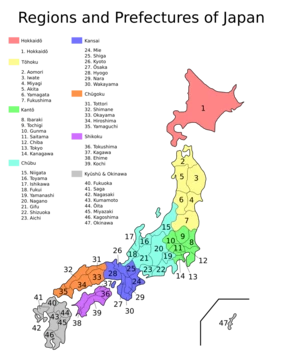
Okayama Prefecture (岡山県, Okayama-ken) is a prefecture of Japan located in the Chūgoku region of Honshu. It has a population of 1,815,165 (as of 1 October 2025) and a geographic area of 7,114 km². The capital and largest city is Okayama, with other major cities including Kurashiki, Tsuyama, and Sōja. The prefecture is bordered by Tottori Prefecture to the north, Hyōgo Prefecture to the east, and Hiroshima Prefecture to the west, and faces Kagawa Prefecture across the Seto Inland Sea, connected by the Great Seto Bridge.
- Capital
- Okayama
- Population
- 1,815,165 (1 October 2025)
- Area
- 7,114 km² (2,746 sq mi)
- Region
- Chūgoku region, Honshu
- Notable for
- Association with the Momotarō legend; historic town of Kurashiki; Bizen-yaki pot
Verified Timeline
Lore & Background
Prior to the Meiji Restoration of 1868, the area of present-day Okayama Prefecture was divided between Bitchū, Bizen and Mimasaka Provinces. The prefecture was formed and named in 1871 as part of the large-scale administrative reforms of the early Meiji period, and its borders were set in 1876. The prefecture's south lies on the Seto Inland Sea coast, while the north is characterized by the Chūgoku Mountains.
Reader's Guide
Okayama Prefecture is historically significant as the setting for the Momotarō legend, a folklore hero said to have roots in the story of Kibitsuhiko-no-mikoto defeating Prince Ura. The city of Okayama holds an annual Momotarō Festival. Culturally, it is known for Bizen-yaki pottery and Bizen Osafune/Bitchu Aoe swords. Tourist attractions include Koraku-en Japanese garden, Okayama Castle, the Bikan Historical Area in Kurashiki, and Bitchu Matsuyama Castle. The prefecture has experienced continual negative population growth since 2005, with more than half of its municipalities designated as depopulated. It is home to several universities, including Okayama University, and sports teams such as Fagiano Okayama FC.
Did You Know?
- Okayama Prefecture includes 90 islands in the Seto Inland Sea.
- As of 1 April 2014, 11% of the prefecture's total land area was designated as Natural Parks.
- The prefecture's borders were set in 1876, five years after its formation in 1871.
- More than half of the prefecture's municipalities are officially designated as depopulated.
- The Momotarō legend is said to have roots in the story of Kibitsuhiko-no-mikoto defeating Prince Ura of Kudara.
Geography & Natural Landscape
Okayama Prefecture stretches across a strikingly diverse landscape on Honshu's Chūgoku region, spanning 7,114 square kilometers. Its northern reaches are dominated by the rugged Chūgoku Mountains, while the southern coastline opens onto the Seto Inland Sea, where the prefecture claims 90 islands scattered across the water. Across the sea lies Kagawa Prefecture on Shikoku island, linked to Okayama by the iconic Great Seto Bridge. This north-south contrast creates a dramatic topographical range within a single administrative unit. As of 1 April 2014, eleven percent of the prefecture's total land area was formally protected as Natural Parks, including Daisen-Oki and Setonaikai National Parks, the Hyōnosen-Ushiroyama-Nagisan Quasi-National Park, and seven additional Prefectural Natural Parks. The prefecture shares borders with Tottori to the north, Hyōgo to the east, and Hiroshima to the west, placing it at a crossroads of western Japan's regional geography.
Historical Formation & Administrative Identity
Before the sweeping administrative reorganization that followed the Meiji Restoration of 1868, the territory now known as Okayama Prefecture did not exist as a unified entity. Instead, it was split among three distinct provinces: Bitchū, Bizen, and Mimasaka, each carrying its own historical identity and local governance traditions. The modern prefecture was formally established and named in 1871 as part of the early Meiji government's large-scale effort to restructure Japan's provincial system into a centralized prefectural framework. The borders we recognize today were finalized in 1876, after which the administrative boundaries have remained stable. This relatively recent creation means that Okayama's identity as a coherent regional unit is younger than many other Japanese prefectures, yet it has since developed a strong sense of shared cultural heritage, from Bizen pottery to the Momotarō legend, that transcends the old provincial divisions.
Cultural Heritage & Folklore
Okayama Prefecture carries a rich cultural legacy that blends artisanal tradition with one of Japan's most beloved folk narratives. The region is renowned for Bizen-yaki, a style of pottery, and for the legendary Bizen Osafune and Bitchu Aoe swords, both celebrated in Japanese metallurgical history. Perhaps most iconically, the prefecture is the traditional homeland of Momotarō, the peach-born hero whose tale is said to derive from the older legend of Kibitsuhiko-no-mikoto and Prince Ura of Kudara, a troublemaker who dwelt in Kinojo (castle of the devil) and was ultimately defeated by the emperor's champion. The city of Okayama honors this story each year with the Momotarō-matsuri festival. Beyond folklore, the prefecture hosts a dense concentration of cultural institutions, including the Hayashibara Museum of Art, the Okayama Prefectural Museum of Art, the Yumeji Art Museum, the Ohara Museum of Art in Kurashiki, and the Okayama Symphony Hall, ensuring that visual and performing arts remain central to daily life.
Demographic Challenges & Urban-Rural Tension
Okayama Prefecture, home to approximately 1.8 million residents as of October 2025, faces a demographic reality that mirrors broader challenges across rural Japan. Census data confirms a pattern of continual negative population growth stretching back to 2005, a trend that has deepened the divide between its urban cores and peripheral communities. The vast majority of residents cluster around the twin anchors of Okayama city, the prefectural capital and largest urban center, and the historic port town of Kurashiki, with Tsuyama and Sōja serving as secondary nodes. In stark contrast, the small villages scattered through the northern mountain region are aging rapidly and losing residents at accelerating rates. More than half of the prefecture's municipalities now carry an official depopulation designation, a bureaucratic acknowledgment that these communities are shrinking beyond the point of sustainable self-governance. This concentration of people in a few coastal and river-valley cities while the highland periphery empties creates ongoing pressure on local services, transportation networks, and the economic viability of rural areas.
Frequently Asked Questions
Who is Okayama Prefecture?
Okayama is a mid-size prefecture in the Chūgoku region on Honshu's western coast, with the city of Okayama serving as both its administrative seat and most populous urban center. As of October 2025, roughly 1.8 million residents call its 7,114 square kilometers home.
What are Okayama Prefecture's powers/role?
The prefecture is best known as the legendary home of the Momotarō tale, for the preserved Edo-era canal town of Kurashiki, and for the centuries-old Bizen-yaki pottery tradition. It also hosts Koraku-en, one of Japan's celebrated strolling gardens.
How does Okayama Prefecture's story end?
Because it is a living place rather than a finished narrative, Okayama's 'story' is still unfolding as a cultural and economic hub linking the Chūgoku interior to the Seto Inland Sea. Its ongoing connection to Kagawa Prefecture across the water, bridged by the Great Seto Bridge, keeps it woven into the region's modern infrastructure.
Why is Okayama Prefecture important?
Geographically it sits at a crossroads, bordered by Tottori to the north, Hyōgo to the east, and Hiroshima to the west, making it a natural corridor through western Honshu. Culturally it anchors the Chūgoku region with landmarks like Kurashiki and the Momotarō myth that permeates Japanese folklore.
What is Okayama Prefecture's origin/backstory?
The prefecture's deepest cultural roots trace to the Momotarō folk tale, in which a boy born from a giant peach sets out to slay a demon, a story so central to local identity that it is celebrated in festivals and monuments throughout the area. Its Bizen-yaki pottery heritage stretches back over a millennium, making it one of Japan's oldest continuous ceramic traditions.
More in Japanese Prefectures 1-24
Elsewhere in the Japanese Prefectures universe
Spotted an error? Know more?
This is a living reference — every entry is fact-audited, and reader corrections feed straight into our audit queue. Suggest an edit · See this site's audit record