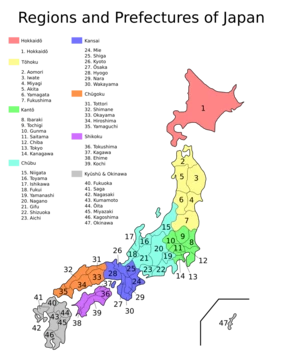
Aomori Prefecture
Northernmost prefecture on Honshu, home to ancient Jōmon pottery.

Aomori Prefecture is a prefecture of Japan in the Tōhoku region. Its capital, largest city, and namesake is the city of Aomori. It is the northernmost prefecture on Japan's main island, Honshu, and is bordered by the Pacific Ocean to the east, Iwate Prefecture to the southeast, Akita Prefecture to the southwest, the Sea of Japan to the west, and Hokkaido across the Tsugaru Strait to the north. Aomori is the eighth-largest prefecture, with an area of 9,645.64 km2, and the 31st-most populous, with more than 1.18 million people. Mount Iwaki, an active stratovolcano, is the prefecture's highest point, at 1,624.7 m. Humans have inhabited the prefecture for at least 15,000 years, and the oldest evidence of pottery in Japan was discovered at the Jōmon period Ōdai Yamamoto I Site.
- highest_point
- Mount Iwaki (1,624.7 m, an active stratovolcano)
Lore & Background
Humans have inhabited Aomori Prefecture for at least 15,000 years. The oldest evidence of pottery in Japan was found at the Ōdai Yamamoto I Site in the town of Sotogahama. During the Jōmon period, the Sannai-Maruyama Site in present-day Aomori city showed evidence of wide interaction with people from across Japan, including Hokkaido and Kyushu. The settlement ended around 2,300 BCE, likely due to a subsistence economy unable to sustain growth and reduced natural resources during a neoglaciation. The Jōmon period continued at the Kamegaoka site in the city of Tsugaru, where small statuettes called Shakōkidogū have been found. After centuries of rule by the Nanbu and Tsugaru clans, the prefecture was formed out of the northern part of Mutsu Province during the Meiji Restoration in the 19th century. The entire Tōhoku region, including Aomori Prefecture, experienced significant growth in population and economy until the late 20th century, when a significant population decline began.
Reader's Guide
Aomori Prefecture holds significant historical and cultural importance in Japan. It is the northernmost prefecture on Honshu and contains the oldest known pottery in Japan, marking the beginning of the Jōmon period. The prefecture's history includes rule by the Nanbu and Tsugaru clans before being formed from northern Mutsu Province during the Meiji Restoration. Its economy is dominated by primary sector industries, especially apple orchards, and it is the largest producer of black garlic in Japan. The prefecture is also a transportation and logistics hub due to its location. Culturally, Aomori is the birthplace of the traditional Tsugaru-jamisen and hosts the noted Aomori Nebuta Matsuri. Its religious beliefs are heavily rooted in Shinto and Buddhism, and it is noted for its blind mediums and the purported tomb of Jesus.
Did You Know?
- The oldest evidence of pottery in Japan was discovered at the Ōdai Yamamoto I Site in Aomori Prefecture, dating the Jōmon period to about 15,000 years ago.
- Aomori is the largest producer of black garlic in Japan.
- The prefecture is the birthplace of the traditional Tsugaru-jamisen, a local version of the three-stringed shamisen.
- Mount Iwaki, the highest point in Aomori at 1,624.7 m, is an active stratovolcano.
- Aomori Prefecture is noted for its blind mediums and the purported tomb of Jesus.
Geographic Position & Natural Landscape
Aomori Prefecture occupies the northernmost tip of Honshu, Japan's main island, making it the closest mainland point to Hokkaido across the Tsugaru Strait. Its borders are defined by water on three sides: the Pacific Ocean to the east, the Sea of Japan to the west, and the strait to the north. To the southeast lies Iwate Prefecture, and to the southwest, Akita. Spanning 9,645.64 square kilometers, it ranks as the eighth-largest prefecture in the country, yet its population of just over 1.18 million places it at 31st in density. The landscape is crowned by Mount Iwaki, an active stratovolcano reaching 1,624.7 meters, which stands as the prefecture's highest point. The name Aomori itself translates to 'blue (or green) forest', a reference to a small forest on a hill near the port settlement established by the Hirosaki Domain in 1624, once used by fishermen as a landmark.
Deep Time & the Jōmon Inheritance
Few places on Earth can claim a human story stretching back 15,000 years, yet Aomori Prefecture does. The Ōdai Yamamoto I Site in the town of Sotogahama yielded the oldest known pottery evidence in all of Japan, pushing the Jōmon period's beginning to roughly 15,000 years ago. By 7,000 BCE, fishing communities had taken root along the prefecture's shores, and around 3,900 BCE, the settlement at Sannai-Maruyama in present-day Aomori city flourished, showing evidence of wide-ranging interaction with peoples from Hokkaido to Kyushu. That community eventually faded around 2,300 BCE, likely because a neoglaciation reduced the natural resources its subsistence economy depended upon. The Jōmon presence continued until 300 BCE at the Kamegaoka site in the city of Tsugaru, where small statuettes called Shakōkidogū were unearthed. Today, the Jōmon Prehistoric Sites in Northern Japan and the Shirakami-Sanchi landscape both hold World Heritage status, anchoring Aomori's identity in prehistory.
Economic Character & Modern Industry
Aomori's economy remains anchored in primary sector activity, with apple orchards forming the backbone of agricultural output. The prefecture also holds the distinction of being Japan's largest producer of black garlic, a niche crop that has gained national recognition. Its strategic position between Honshu and Hokkaido, coupled with access to both the Pacific and the Sea of Japan, makes it a natural transportation and logistics hub. Tourism contributes meaningfully to the local economy, drawing visitors to the Jōmon Prehistoric Sites and the Shirakami-Sanchi World Heritage landscape. After a long period of population and economic growth that carried through much of the 20th century, the broader Tōhoku region, Aomori included, entered a significant population decline in the late 1900s. The prefecture was formally created during the Meiji Restoration of the 19th century, carved from the northern portion of the old Mutsu Province, following centuries of rule by the Nanbu and Tsugaru clans.
Cultural Distinctiveness & Living Traditions
Aomori's remoteness from Japan's central government, combined with its long, heavy-snow winters, has fostered a subculture that feels distinctly its own. The prefecture is the birthplace of the Tsugaru-jamisen, a local variant of the three-stringed shamisen that has become a signature of the region's musical identity. Crafts such as embroidery, pottery, lacquerware, cabinetry, and iron working carry deep local traditions, while the cuisine is marked by distinctive porridges and soups. The Aomori Nebuta Matsuri stands as the most celebrated of the prefecture's many festivals. Sports culture is active, with teams competing in association football, baseball, basketball, and ice hockey. Religious life is deeply rooted in both Shinto and Buddhism, and the prefecture is noted for its blind mediums and a purported tomb of Jesus. These layers of art, faith, and communal celebration give Aomori a cultural texture unlike any other corner of Honshu.
Frequently Asked Questions
Who is Aomori Prefecture?
Aomori is the northernmost prefecture on Honshu, Japan's main island, situated in the Tōhoku region. Its capital and largest city shares the same name, Aomori, anchoring the region's identity.
What are Aomori Prefecture's signature traits or "powers"?
The prefecture claims its region's highest elevation with Mount Iwaki, a dormant volcano reaching 1,624.7 meters. It also holds the distinction of containing the oldest known pottery evidence in all of Japan, unearthed at the Jōmon-period Ōdai Yamamoto I Site.
What makes Aomori Prefecture's culture stand out from its neighbors?
Its remote northern position and long, heavy-snow winters have shaped a distinctive local subculture that sets it apart from other Tōhoku communities. This combination of isolation and climate gives Aomori a unique identity within the region.
Why is Aomori Prefecture important to Japan's broader story?
It is the site where the earliest pottery in Japan was discovered, pushing back the timeline of human artistic expression on the archipelago. As the northernmost prefecture on Honshu, it also serves as the country's geographic gateway to the far north.
Where exactly does Aomori Prefecture sit on the map?
It occupies the northern tip of Honshu within the Tōhoku region, making it the topmost prefecture on Japan's main island. Its capital, Aomori City, serves as both the administrative center and the largest urban area in the prefecture.
More in Japanese Prefectures 1-24
Elsewhere in the Japanese Prefectures universe
Spotted an error? Know more?
This is a living reference — every entry is fact-audited, and reader corrections feed straight into our audit queue. Suggest an edit · See this site's audit record