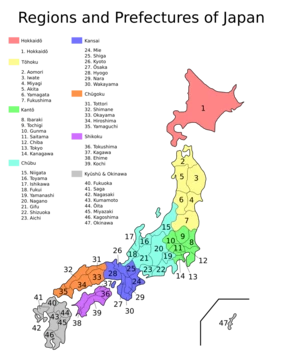
Fukuoka Prefecture
Northern Kyūshū prefecture with major industry and historic temples.

Fukuoka Prefecture is a prefecture of Japan located on the island of Kyūshū, at its northernmost point on the Kanmon Straits. It is notable for being the most populous prefecture on Kyūshū and a major industrial center, accounting for nearly 40% of the economy of Kyūshū, with a GDP exceeding 154 billion US dollars.
- population
- 5,081,879 (1 October 2025)
- area
- 4,986 square kilometres (1,925 sq mi)
- capital
- Fukuoka
- largest_city
- Fukuoka
- major_cities
- Kitakyushu, Kurume, Ōmuta
- bordering_prefectures
- Saga, Kumamoto, Ōita
- ichinomiya
- Kōra taisha, Sumiyoshi-jinja, Hakozaki-gū
Verified Timeline
Lore & Background
Fukuoka Prefecture includes the former provinces of Chikugo, Chikuzen, and Buzen. It faces the sea on three sides and borders Saga, Ōita, and Kumamoto prefectures, facing Yamaguchi Prefecture across the Kanmon Straits. The prefecture includes two of Kyūshū's largest cities, Fukuoka and Kitakyushu, and much of Kyūshū's industry, along with several small islands near the north coast. Historically, the prefecture contains several important Buddhist temples. Monk Eisai founded Shōfuku-ji, known as the oldest zen temple in Japan. Monk Kukai established Tocho-ji, and Joten-ji was built by Enni, who also brought Udon noodles to Japan. The oldest temple is Kanzeon-ji, founded by the Emperor in Dazaifu during the 7th century to honor his mother; together with Kaidan-in, it was one of three places in Japan where Buddhist monks could ordain. During the Tokugawa shogunate, daimyo Arima Toyōji moved his family temple to Kurume City, now known as Bairin-ji, a main temple for zen practice in Fukuoka Prefecture and Kyushu.
Reader's Guide
Fukuoka Prefecture is significant as the economic and industrial heart of Kyūshū, with major industries including automobiles, semiconductors, and steel. It is the birthplace of tire manufacturer Bridgestone and consumer electronics chain Best Denki, and hosts headquarters of companies such as TOTO Ltd., Yasukawa Electric Corporation, and LEVEL-5 Inc. The prefecture is home to Kyushu University, one of Japan's top five universities. Culturally, Fukuoka Prefecture features numerous museums, including the Fukuoka Art Museum, Fukuoka Asian Art Museum, and Kyushu National Museum. Major festivals include Hakata Gion Yamakasa and Hakata Dontaku Harbour Festival. The prefecture hosts sports teams such as Avispa Fukuoka, Fukuoka SoftBank Hawks, and the Fukuoka International Cross Country competition. It also hosted the Fukuoka Marathon, where world records were set twice during its 75-year existence, with its final race in 2021. Fukuoka Prefecture has the most designated yakuza groups among all prefectures, at five, and led the nation in gun-related incidents between 2004 and 2009 and in early 2011. It also had the highest frequency of youth crime from 2003 to 2007. As of 2017, its crime rate was the eighth-highest in Japan.
Did You Know?
- Monk Eisai founded Shōfuku-ji, known as the oldest zen temple in Japan.
- Monk Enni is credited with bringing udon noodles to Japan when he built Joten-ji.
- Kanzeon-ji and Kaidan-in were one of only three places in Japan where Buddhist monks could ordain.
- Fukuoka Prefecture has the most designated yakuza groups among all prefectures, at five.
- The Fukuoka Marathon, hosted by the prefecture, saw world records set twice during its 75-year existence, with its final race in 2021.
Strategic Position at the Crossroads of the Sea
Fukuoka Prefecture occupies a uniquely commanding spot at the northern tip of Kyūshū, where the island meets the Kanmon Straits. This narrow waterway links the Tsushima Strait with the Seto Inland Sea and places the prefecture directly across from Yamaguchi Prefecture on Honshu, making it Japan's closest point to the main island from the southwest. Stretching southward to the Ariake Sea, the region is flanked by water on three sides while sharing land borders with Saga to the southwest, Kumamoto to the south, and Ōita to the southeast. Its total area spans roughly 4,986 square kilometres and includes a scattering of small islands off the northern coast. A full 18 percent of that land is set aside as protected natural space, ranging from Setonaikai National Park to several quasi-national and prefectural parks. This coastal geography has long shaped the prefecture's identity as a gateway between Kyūshū and the wider Japanese archipelago, a role that continues to influence both its cultural exchanges and its economic connections.
Industrial Heart of Kyūshū
The urban core of Fukuoka Prefecture functions as one of Japan's principal manufacturing hubs, generating nearly forty percent of Kyūshū's total economic output. Its gross domestic product surpasses 154 billion US dollars, a figure comparable to that of a mid-sized nation. The industrial base rests heavily on automobile production, semiconductor fabrication, and steelmaking, yet the prefecture's corporate legacy stretches far beyond heavy industry. It is the birthplace of Bridgestone, the tire giant, and Best Denki, the consumer electronics retailer, both of which grew from local roots into national brands. A long list of well-known firms call Fukuoka home, including TOTO (established 1917), Yasukawa Electric (1915), and the footwear company MoonStar (1873). More recent entrants such as LEVEL-5 (1998) and Star Flyer (2002) reflect the region's ongoing innovation in gaming and aviation. The presence of Kyushu University, ranked among Japan's top five institutions, further anchors the prefecture as a centre of research and talent that feeds directly into its industrial ecosystem.
A Living Tapestry of Shrines and Zen Foundations
Fukuoka Prefecture inherits the spiritual legacy of three ancient provinces—Chikugo, Chikuzen, and Buzen—and its sacred landscape reflects centuries of exchange with the Asian continent. Three Shinto shrines hold the rank of ichinomiya: Kōra taisha, Sumiyoshi-jinja, and Hakozaki-gū. On the Buddhist side, the story is one of monks arriving by sea from China and planting new houses of worship in what is now Fukuoka City. Eisai, returning from his studies abroad, founded Shōfuku-ji, recognised today as Japan's oldest Zen temple. Kukai established Tocho-ji, while the monk Enni built Joten-ji and is also credited with introducing udon noodles to the country. The oldest temple of all is Kanzeon-ji, erected by an emperor in Dazaifu during the seventh century in honour of his mother; together with its former annex Kaidan-in, it served as one of only three ordination sites in Japan. During the Tokugawa era, daimyō Arima Toyōji relocated his family temple to Kurume, where it endures as Bairin-ji, the principal Zen practice centre for both the prefecture and the broader Kyūshū region.
A Population at a Turning Point
For decades, Fukuoka Prefecture was one of the rare Japanese prefectures whose population grew steadily, climbing to 5,135,214 by the 2020 Census and earning the ninth-most-populated rank among all forty-seven prefectures. That trajectory, however, has recently reversed. National Institute of Population and Social Security Research projections estimated the figure would slip to roughly 5,088,000 by 2025 and fall below the five-million threshold by 2030. The 2025 Census confirmed the decline, recording 5,081,879 residents—a drop of 53,335 people, or one percent, since 2020, matching earlier forecasts almost exactly. Ironically, the shrinking population nudged Fukuoka upward in the national ranking: it moved from ninth to eighth place because Hokkaido experienced a proportionally steeper loss. The prefecture thus stands at a demographic crossroads, having sustained growth for generations and now confronting the first sustained contraction in its modern history, a shift that will shape housing, labour markets, and public services in the years ahead.
Frequently Asked Questions
Who is Fukuoka Prefecture?
Fukuoka is the northernmost prefecture on Kyūshū, perched at the island's tip where the Kanmon Straits open up. It takes its name from its capital, which is also its largest city, and it anchors the region alongside Kitakyushu, Kurume, and Ōmuta.
What are Fukuoka Prefecture's powers and role?
Fukuoka acts as Kyūshū's industrial and commercial engine, producing roughly 40% of the island's total GDP. Its dense manufacturing base and major port infrastructure give it outsized influence over regional trade and logistics.
How does Fukuoka Prefecture's story end?
As a living, ongoing region, Fukuoka has no fixed narrative conclusion; its arc continues through sustained population growth and industrial expansion. With a population exceeding five million by late 2025, it remains Kyūshū's most populous and economically dominant prefecture.
Why is Fukuoka Prefecture important?
Fukuoka underpins Kyūshū's economy with a GDP above 154 billion US dollars and a population of roughly 5.08 million. Its position at the island's northern tip also makes it the primary gateway for maritime and air links to mainland Japan and across the strait to the Asian continent.
Who are Fukuoka Prefecture's closest allies?
Fukuoka shares land borders with Saga to the west, Kumamoto to the south, and Ōita to the east. These three neighboring prefectures form its immediate regional network on Kyūshū.
More in Japanese Prefectures 1-24
Elsewhere in the Japanese Prefectures universe
Spotted an error? Know more?
This is a living reference — every entry is fact-audited, and reader corrections feed straight into our audit queue. Suggest an edit · See this site's audit record