Ehime Prefecture
Shikoku prefecture known for citrus, hot springs, and Nobel laureates.

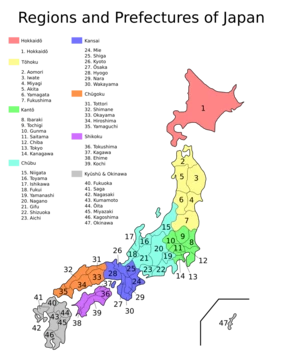
Ehime Prefecture is a prefecture of Japan located on the island of Shikoku. It has a population of 1,334,841 and a geographic area of 5,676 km2 (2,191 sq mi). Matsuyama is the capital and largest city of Ehime Prefecture and the largest city on Shikoku. Notable past Ehime residents include three Nobel Prize winners: Kenzaburo Oe (1994 Nobel Prize in Literature), Shuji Nakamura (2014 Nobel Prize in Physics), and Syukuro Manabe (2021 Nobel Prize in Physics).
- Capital
- Matsuyama
- Population
- 1,334,841
- Area
- 5,676 km² (2,191 sq mi)
- Island
- Shikoku
- Notable Nobel Laureates
- Kenzaburo Oe (Literature, 1994), Shuji Nakamura (Physics, 2014), Syukuro Manabe
Verified Timeline
Lore & Background
Until the Meiji Restoration, Ehime Prefecture was known as Iyo Province. Since before the Heian period, the area was dominated by fishermen and sailors who played an important role in defending Japan against pirates and Mongolian invasions. After the Battle of Sekigahara, the Tokugawa shōgun gave the area to his allies, including Katō Yoshiaki who built Matsuyama Castle, forming the basis for the modern city of Matsuyama. The name Ehime comes from the kuniumi part of the Kojiki where Iyo Province is mythologically named Ehime, 'lovely princess'. In 2012, a research group from the University of Tokyo and Ehime University said they had discovered rare earth deposits in Matsuyama.
Reader's Guide
Ehime Prefecture holds significance as a historical and cultural center on Shikoku. Its coastal areas host major industries including shipbuilding, chemical industries, oil refining, and textile production, while rural areas are known for citrus fruits such as mikan and iyokan, as well as cultured pearls. The prefecture is home to the oldest extant hot spring in Japan, Dōgo Onsen, which has been used for over two thousand years. Ehime has produced three Nobel Prize winners: Kenzaburo Oe (Literature, 1994), Shuji Nakamura (Physics, 2014), and Syukuro Manabe (Physics, 2021). The prefecture also features in numerous cultural works, including the novel Botchan by Natsume Sōseki, the television drama Saka no Ue no Kumo, and the film Destruction Babies. Its festivals, such as the Niihama Taiko Festival and Uwajima Ushi-oni Festival, are major cultural events. The Velo-city conference, the world's largest conference dedicated to daily cycling and active mobility, will be held in Ehime in 2027.
Did You Know?
- Ehime Prefecture borders Hiroshima Prefecture for only 74 metres (243 ft) on Hyōtanjima.
- The Sadamisaki Peninsula is the narrowest peninsula in Japan.
- Dōgo Onsen in Matsuyama is the oldest extant hot spring in Japan, used for over two thousand years.
- The Niihama Taiko Festival is one of the three biggest fight festivals in Japan.
- In 2012, a research group from the University of Tokyo and Ehime University discovered rare earth deposits in Matsuyama.
Mythological Roots & Historical Foundations
Long before the Meiji Restoration reorganized Japan's administrative map, this territory was known as Iyo Province, a name that traces back to the Kojiki, Japan's oldest mythological record. In that ancient text, the province is poetically called Ehime, meaning 'lovely princess,' a designation that would eventually become the modern prefecture's name. The region's earliest identity was forged by its maritime communities; even before the Heian period, local fishermen and sailors played a vital defensive role, helping shield the Japanese archipelago from pirate raids and Mongolian invasion attempts. A decisive political shift followed the Battle of Sekigahara, when the victorious Tokugawa shōgun allocated the territory to trusted allies. Among them, Katō Yoshiaki raised Matsuyama Castle, an act that seeded the growth of what would become the prefecture's capital and largest city. In 2012, a joint research team from the University of Tokyo and Ehime University announced the discovery of rare earth mineral deposits in the Matsuyama area, a finding that underscored the region's ongoing geological significance.
Coastal Mountains & Protected Landscapes
Ehime occupies the northwestern portion of Shikoku, stretching from elevated inland mountain ranges down to an extensive coastline dotted with islands in the Seto Inland Sea. Its borders meet Kagawa Prefecture to the northeast, Tokushima to the east, and Kōchi to the southeast, while a remarkably narrow 74-metre strip of land on the small island of Hyōtanjima connects it to Hiroshima Prefecture. The prefecture covers 5,676 km2 (2,191 sq mi) and is home to approximately 1,334,841 people. One of its most striking geographic features is the Sadamisaki Peninsula, the westernmost projection of the prefecture, which carries the distinction of being Japan's narrowest peninsula. The region's natural diversity is formally safeguarded: as of 31 March 2020, seven percent of total land area is set aside as Natural Parks. These encompass the Ashizuri-Uwakai and Setonaikai National Parks, the Ishizuchi Quasi-National Park, and a web of Prefectural Natural Parks including Hijikawa, Kinshako, Okudōgo Tamagawa, Sadamisaki Hantō-Uwakai, Saragamine Renpō, Sasayama, and the Shikoku Karst, collectively preserving everything from coastal wetlands to limestone karst terrain.
Shipbuilding, Citrus & Energy
Ehime's economic character is defined by a clear divide between its industrial coastal zones and its agricultural interior. The harbours around Imabari and Saijō anchor the manufacturing base, most prominently through the dockyards of Imabari Shipbuilding, which stands as Japan's largest shipbuilder. The broader coastal corridor also hosts chemical plants, oil refineries, and factories producing paper and cotton textiles. In the rural hinterland, the economy centres on agriculture and fishing. The prefecture is especially celebrated for citrus cultivation, with mikan (mandarin oranges) and the locally developed iyokan variety among its signature crops, while its surrounding waters support a cultured pearl industry that has long been a point of local pride. Energy production forms another critical pillar: the Ikata Nuclear Power Plant, located within the prefecture, generates a substantial share of the electricity distributed by Shikoku Electric Power, reinforcing Ehime's role in supplying the wider Shikoku region. Together, these sectors—shipbuilding, heavy industry, agriculture, aquaculture, and nuclear generation—create an economic landscape that spans heavy manufacturing to small-scale farming.
Onsen Heritage, Festivals & Nobel Legacy
Ehime's cultural identity is anchored by Dōgo Onsen in Matsuyama, the most ancient hot spring still in use in Japan, with a documented history exceeding two thousand years and a reference in the Nihon Shoki. The site provides three public bathing facilities: the main building, Tsubaki no Yu, and Asuka no Yu. The prefecture's festival calendar is equally rich. The Uwajima Ushi-oni Festival unfolds over three days of ox-demon parades, traditional dance, a fireworks display, and a closing run. Niihama's autumn Taiko Festival features a massive drum stand hoisted by roughly 150 men, securing its place among Japan's three greatest fight festivals. Matsuyama's Autumn Festival includes the Hachiawase mikoshi procession staged near Dōgo Onsen and Isaniwa Shrine. The region's intellectual legacy is equally remarkable: three Nobel Prize winners—Kenzaburo Oe (Literature, 1994), Shuji Nakamura (Physics, 2014), and Syukuro Manabe (Physics, 2021)—are counted among its notable past residents. Literary ties include Natsume Sōseki's Botchan, set in Matsuyama, and Ryōtarō Shiba's Saka no Ue no Kumo. Looking ahead, Ehime will host the Velo-city conference in 2027, the world's largest dedicated forum on daily cycling and active mobility.
Frequently Asked Questions
Who is Ehime Prefecture?
Ehime is one of Japan's 47 prefectures, situated on the southwestern island of Shikoku with Matsuyama serving as its capital city. It is home to roughly 1.33 million residents spread across about 5,676 square kilometers of coastal and mountainous terrain.
What are Ehime Prefecture's powers and role?
The prefecture is best known for its thriving citrus orchards—especially satsuma mandarin oranges—and its network of natural hot springs that draw visitors year-round. Historically, it functioned as the old Iyo Province, giving it a distinct cultural identity within the Shikoku region.
How does Ehime Prefecture's story end?
As a living, ongoing place rather than a finite narrative, Ehime's 'story' continues through its present-day identity as a hub of agriculture, tourism, and academic achievement. Its legacy is measured not in a final chapter but in the generations that keep building on its coastal and mountainous landscape.
Why is Ehime Prefecture important?
Ehime holds the remarkable distinction of being the birthplace of three Nobel Prize laureates: novelist Kenzaburo Oe (Literature, 1994), physicist Shuji Nakamura (Physics, 2014), and climate scientist Syukuro Manabe (Physics, 2021). This concentration of world-class talent in a single prefecture of about 1.3 million people makes it a standout in Japanese history.
Where is Ehime Prefecture located?
Ehime occupies the northwestern portion of Shikoku, Japan's fourth-largest island, bordering the Seto Inland Sea to the north and the Pacific Ocean to the south. Its 5,676 km² of territory encompasses both rugged coastline and forested highlands.
More in Japanese Prefectures 1-24
Elsewhere in the Japanese Prefectures universe
Spotted an error? Know more?
This is a living reference — every entry is fact-audited, and reader corrections feed straight into our audit queue. Suggest an edit · See this site's audit record