Osaka Prefecture
Second-most-densely populated prefecture in Japan, economic hub of Kansai.

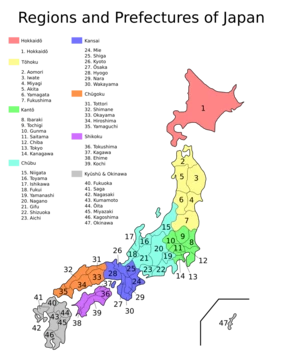
Osaka Prefecture (Ōsaka-fu) is a prefecture of Japan located in the Kansai region of Honshu. It is one of Japan's two "urban prefectures" using the designation fu, along with Kyoto Prefecture, and forms the center of the Keihanshin metropolitan area, the second-most-populated urban region in Japan after the Greater Tokyo area and one of the world's most productive regions by GDP. With a population of 8,778,035 as of 1 April 2022 and a geographic area of 1,905 square kilometres (736 sq mi), it is the third-most-populous prefecture but the second-smallest by area. At 4,600 inhabitants per square kilometre (12,000/sq mi), it is the second-most densely populated prefecture, below only Tokyo.
- population
- 8,778,035 (as of 1 April 2022)
- area
- 1,905 square kilometres (736 sq mi)
- capital
- Osaka
- population_density
- 4,600 inhabitants per square kilometre (12,000/sq mi)
- established
- June 21, 1868
- type
- Urban prefecture (fu)
Verified Timeline
Lore & Background
Osaka Prefecture was created on June 21, 1868, at the very beginning of the Meiji era. Prior to the Meiji Restoration, the modern-day area was split between Kawachi, Izumi, and Settsu provinces. During the instigation of Fuhanken Sanchisei in 1868, the prefecture received its suffix fu. On September 1, 1956, the city of Osaka was promoted to a city designated by government ordinance and divided into 24 wards. Sakai became the second city in the prefecture to be promoted to a city designated by government ordinance on April 1, 2006, and was divided into seven wards. In 2000, Fusae Ota became Japan's first female governor when she replaced Knock Yokoyama, who resigned after prosecution for sexual harassment. Tōru Hashimoto, previously famous as a counselor on television, was elected in 2008 at the age of 38, becoming the youngest governor in Japan. On June 18, 2018, an earthquake struck the northern region of the prefecture. It killed 4 people and caused minor damage across Greater Osaka. A proposed reorganisation to reform Osaka Prefecture into the Osaka Metropolis and merge with the City of Osaka was backed by Governor Tōru Hashimoto. A referendum on the issue was held in 2015 and was defeated with 50.38% of voters opposed to the plan. A second referendum in 2020 was rejected by 50.6% of voters.
Reader's Guide
Osaka Prefecture is significant as the third-most-populous prefecture in Japan and the second-most densely populated, below only Tokyo. It is one of only two prefectures designated as fu, reflecting its historical and administrative importance. The prefecture forms the core of the Keihanshin metropolitan area, a globally significant economic region. Its economy is notable for the high proportion of output from small and medium enterprises (SMEs), which accounted for 65.4% of manufactured output in the prefecture, significantly higher than Tokyo's 55.5% or Kanagawa's 38.4%. Major companies include electronics giants Panasonic and Sharp. The prefecture also hosts the Osaka Securities Exchange, specializing in derivatives such as Nikkei 225 Futures. Demographically, Osaka Prefecture has the largest ethnic Korean population of any prefecture in Japan, with about 93,000 persons as of 2022, a legacy of migration during the Japanese rule of Korea. The prefecture's cultural landmarks include Shitennō-ji, Kanshin-ji, and Sumiyoshi Taisha, as well as the Expo Commemoration Park, site of Expo '70. Its universities include Osaka University, Kansai University, and Kindai University.
Did You Know?
- Osaka Prefecture is one of Japan's two 'urban prefectures' using the designation fu, along with Kyoto Prefecture.
- Fusae Ota became Japan's first female governor when she replaced Knock Yokoyama in 2000.
- Tōru Hashimoto was elected governor in 2008 at age 38, becoming the youngest governor in Japan.
- As of 2022, Osaka Prefecture has about 93,000 ethnic Korean persons, the largest such population of any prefecture in Japan.
- A 2015 referendum to reform Osaka Prefecture into the Osaka Metropolis was defeated with 50.38% of voters opposed.
Frequently Asked Questions
Who is Osaka Prefecture?
Osaka Prefecture is a densely populated urban prefecture in Japan's Kansai region, home to roughly 8.78 million residents with the city of Osaka as its capital. It carries the special 'fu' designation, a title it shares only with Kyoto Prefecture.
What is Osaka Prefecture's role in the story?
It acts as the economic engine of the Keihanshin metropolitan area, Japan's second-largest urban cluster by population. The prefecture is consistently ranked among the world's most productive regions by GDP output.
Where does Osaka Prefecture live?
It sits in the Kansai region on Honshu, covering approximately 1,905 square kilometres of land. At around 4,600 people per square kilometre, it is the second-most-densely populated prefecture in the country.
Why is Osaka Prefecture important?
It anchors the Keihanshin metro area, the second-most-populated urban region in Japan after Greater Tokyo. Its blend of extreme density, industrial output, and urban infrastructure makes it a critical pillar of the national economy.
When was Osaka Prefecture established?
The prefecture was formally created on June 21, 1868, during the early Meiji period when Japan reorganized its administrative divisions. It has operated as a 'fu' (urban prefecture) ever since.
More in Japanese Prefectures 1-24
Elsewhere in the Japanese Prefectures universe
Spotted an error? Know more?
This is a living reference — every entry is fact-audited, and reader corrections feed straight into our audit queue. Suggest an edit · See this site's audit record