Tottori Prefecture
Japan's least populous prefecture, home to its largest sand dunes.

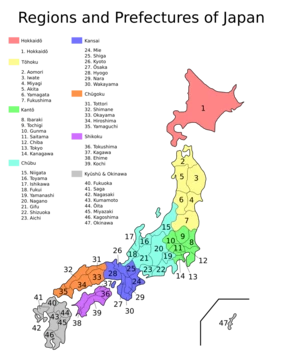
Tottori Prefecture is a prefecture of Japan located in the Chūgoku region of Honshu. It is the least populous prefecture in Japan, with a population of 538,525 as of 2023, and covers an area of 3,507.13 square kilometers. Tottori is the capital and largest city, and the prefecture is home to the Tottori Sand Dunes, the largest sand dune system in Japan, and Mount Daisen, the highest peak in the Chūgoku Mountains. Tottori Prefecture borders Shimane Prefecture to the west, Hiroshima Prefecture to the southwest, Okayama Prefecture to the south, and Hyōgo Prefecture to the east.
- Capital
- Tottori
- Population
- 538,525 (2023)
- Area
- 3,507.13 km²
- Region
- Chūgoku, Honshu
- Known for
- Tottori Sand Dunes, Mount Daisen, largest coffee consumer per household in Japan
Verified Timeline
Lore & Background
The name 'Tottori' first appears in the Nihon shoki in the 23rd year of Emperor Suinin (213 AD). An elder from Izumo, Yukuha Tana, presented a swan to the emperor, and the imperial prince Homatsu-wake, who was 30 and unable to speak, played with the swan and learned to speak. Yukuha Tana was granted the title Tottori no Miyakko. The area was settled very early, with remains from the Jōmon period (14,000–300 BC). The prefecture contains the largest known Yayoi period (300 BC–250 AD) settlement in Japan, the Mukibanda Yayoi remains, in the foothills of Mount Daisen. In 645, under the Taika reforms, the area became two provinces, Hōki and Inaba. During the Genpei War (1180–1185), Tottori became a base for anti-Taira forces at Daisen-ji and Sanbutsu-ji. After the Battle of Sekigahara in 1600, the Tokugawa shogunate installed the Ikeda clan at Tottori Castle, which controlled the area throughout the Edo period (1603–1868). The boundaries of Tottori Prefecture were established in 1888. In 1943, a magnitude 7.2 earthquake destroyed 80% of the city of Tottori.
Reader's Guide
Tottori Prefecture is heavily agricultural, shipping nashi pears, nagaimo yam, Japanese scallion, negi, and watermelon to major cities, and is a major rice producer. It has the lowest population in Japan but the biggest coffee consumption per household. The Tottori Sand Dunes are Japan's only large dune system. As of 1 April 2012, 14% of the prefecture's land was designated as Natural Parks, including Daisen-Oki and Sanin Kaigan National Parks. Notable sites include Jinpūkaku in Tottori City, the Mukibanda Yayoi remains in Daisen and Yonago, Nakaumi lake (fifth largest in Japan) between Yonago and Sakaiminato, Misasa Onsen and Sanbutsu-ji (a National Treasure) in Misasa, Kitarō Road in Sakaiminato, Uradome Coast in Iwami, the Ishitani Residence (a National Treasure) in Chizu, and Tottori Hanakairo-Flower Park (largest flower park in Japan) in Nanbu. The prefecture's symbol, adopted in 1968, combines the first mora 'と' with a flying bird, symbolizing peace, liberty, and advancement.
Did You Know?
- Tottori Prefecture has the lowest population of any Japanese prefecture, at 538,525 as of 2023.
- The name 'Tottori' first appears in the Nihon shoki in 213 AD, when an elder named Yukuha Tana presented a swan to the emperor.
- The 1943 Tottori earthquake, magnitude 7.2, destroyed 80% of the city of Tottori.
- Tottori Prefecture has the biggest coffee consumption per household in Japan.
- The Mukibanda Yayoi remains are the largest known Yayoi period settlement in Japan.
Frequently Asked Questions
Who is Tottori Prefecture?
Tottori is a prefecture situated in the Chūgoku region of Honshu, Japan, with Tottori City as its capital and largest urban center. It holds the unique distinction of being the least populous of all 47 Japanese prefectures.
What are Tottori Prefecture's signature powers?
Its headline features are the Tottori Sand Dunes, the largest dune system anywhere in Japan, and Mount Daisen, the highest peak in the Chūgoku Mountains. It also claims the record for the highest per-household coffee consumption in the country.
How does Tottori Prefecture's story end?
Because Tottori is a living, ongoing place rather than a finished narrative, its arc has no fixed ending. As of 2023 it remains an active prefecture of roughly 538,525 residents spread across 3,507 square kilometers, still writing its own chapter.
Why is Tottori Prefecture important to the overall lineup?
It stacks multiple national superlatives—smallest population, biggest sand dunes, top coffee drinkers per household—into a single entry, giving it a highly recognizable identity among Japan's 47 prefectures.
What is Tottori Prefecture's main weakness?
With just over half a million people, it has the smallest demographic footprint in the country, which can constrain economic scale, infrastructure funding, and political weight relative to denser neighboring prefectures.
More in Japanese Prefectures 1-24
Elsewhere in the Japanese Prefectures universe
Spotted an error? Know more?
This is a living reference — every entry is fact-audited, and reader corrections feed straight into our audit queue. Suggest an edit · See this site's audit record