Frequently Asked Questions
The most-asked questions about japanese prefectures.
What exactly are Japanese prefectures?
Japanese prefectures are the country's 47 first-level administrative divisions, serving as the primary layer of local government beneath the national level. They fall into four formal designations—metropolis, capital prefecture, prefecture, and regular prefecture—though all function essentially the same way in practice.
How many prefectures does Japan have?
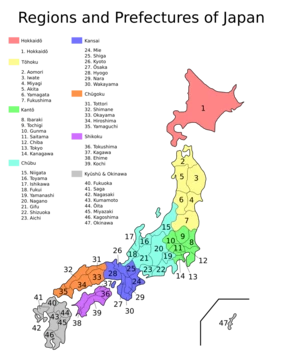
Japan has 47 prefectures in total: 43 designated as 'ken,' one as 'to' (Tokyo), one as 'do' (Hokkaido), and two as 'fu' (Osaka and Kyoto).
What is the practical difference between ken, to, do, and fu?
The distinction is almost entirely historical and ceremonial, carrying over older administrative titles from the Edo and early Meiji periods. In government operations and daily conversation, all 47 units exercise identical powers and are simply called 'prefectures.'
What are the eight geographic regions of Japan?
The 47 prefectures are conventionally grouped into eight regions: Hokkaido, Tohoku, Kanto, Chubu, Kansai (Kinki), Chugoku, Shikoku, and Kyushu-Okinawa. These are cultural and geographic clusters rather than an additional tier of government.
Where should a newcomer start learning about the prefectures?
A practical entry point is memorizing the eight regional groupings, then working through one region at a time beginning with the densely populated Kanto area that contains Tokyo. Comparing coastal versus inland prefectures within each region helps build an intuitive geographic mental map.
Which prefecture is the most populous and which is the smallest by area?
Tokyo Metropolis is both the most populous at roughly 14 million residents and the smallest in land area at about 2,194 square kilometers. At the opposite extreme, Hokkaido spans over 83,000 square kilometers with a population of only around 5 million.
How did the modern prefecture system come into existence?
The Meiji government dismantled the feudal han (domain) system in 1871 and replaced it with centrally administered prefectures, with subsequent mergers and splits over the next several decades settling the count at 47. Okinawa Prefecture was the final addition, joining the system in 1972 after the end of U.S. military administration.
What powers do prefectural governments actually hold?
Each prefecture elects a governor and a unicameral assembly, and they manage education, public health, road infrastructure, and regional planning within their borders. They also issue local ordinances and coordinate disaster response, all operating under the framework established by national law.
Are any of the prefectures composed entirely of islands?
Okinawa Prefecture is made up almost entirely of the Ryukyu Islands, extending far south into the East China Sea. Several other prefectures, including Kagoshima, Ehime, and Tokyo, also incorporate significant island territories in their jurisdiction.
What is a commonly cited fun fact about Japanese prefectures?
Kagawa Prefecture is the smallest in land area at roughly 1,877 square kilometers, while Niigata holds the longest coastline of any prefecture. Every prefecture also carries a unique license-plate code, making them easy to identify on the road.